Wednesday, January 26, 2011

Basic sketching and rendering

Basic rendering techniques
1. Stippling
2. Scribbling
3. Criss-cross
4. Cross hatching
5. Free hand vertical lines
6. Free hand horizontal lines
7. Free hand diagonal lines
8. Free hand circles
9. Curved lines


Sketches using basic rendering


Rendering with other medium like

1. Charcoal pencil
2. Colour pencil
3. Oil pastel
4. Dry pastel


Warm colour and cool colour scheme


One point perspective  


Two point perspective


Colour wheel


Colour scheme

Monochromatic colours


Complimentary Colours

Analogous Colours


Motif
Any shape including one or all elements of design with minimal shape is called a motif.
Combination of many motifs is called a pattern.
Types of motif
Natural, Geometrical, Stylized, Abstract, Ornamental, Simplified, Materialized.
Natural: representing nature.


Geometric: every lines and details are measured.


Stylized: deforming the existing shape.


Abstract: it does not have any defined shape.
.
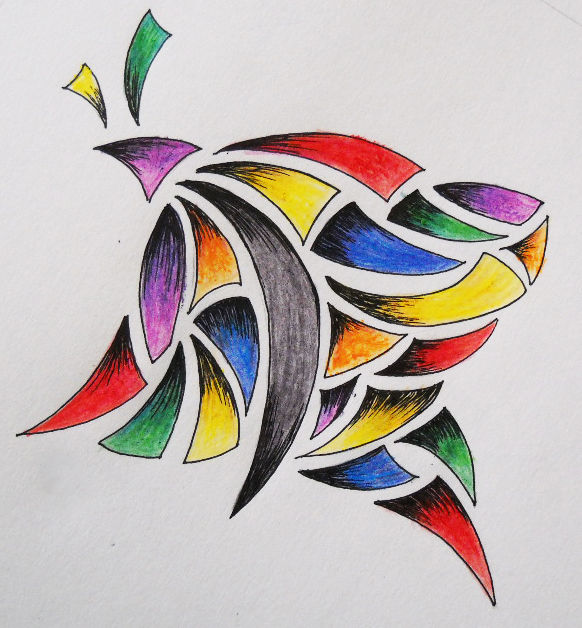
Ornamental: they are more detailed.


Simplified: minimal lines and design features


Materialized: every line should have a connection with each other forming a material.


Design types
Traditional, historical, oriental, contemporary, regional.
Traditional: design follow from generation to generation.
Historical: primitive textile design.
Oriental: design from the eastern part of the world (China, Japan)
Contemporary: designers perspective in modification of historical and traditional designs according to latest trends.
Regional: design ideas of a particular region.

Elements of design 

  • Line
  • Colour
  • Texture (Visual)

  • Texture (Tactile)

  • Shape

  • Form
Principles of design
  • Balance


  • Harmony
  • Emphasis
  • Proportion
  • Rhythm


Wednesday, January 12, 2011

Basic textile science

Yarn
  • It is a long continues length of interlocked fibers twisted which is used in weaving, knitting, sewing, crochet, embroidery.. Etc.
Yarn twist
  • The amount of twist is the important factor in finished consumer’s goods. It determines the appearance and durability of the fabric.
  • Fine yarns needs more twist than the coarse yarn (e.g.).: warp needs more twist than the weft.
  • Twist setting finish is given to retain the twist with heat or moisture.
  • Amount of twist also depends upon the fabric to be woven.
  • Soft surface fabric needs slack twist, they are called soft twist yarns.
  • Smooth surface fabric needs more twist which gives strength, smoothness, elasticity, and wrinkle resistance.
  • By holding the yarn in a vertical position we can observe the direction of twist.
  • There are two types of twist "S" and "Z"

Simple yarn:
  • When the staple of filament fibers are twisted together it forms a simple yarn.
  • The yarn strength will not be high as it is just twisted with the fibers.
Ply yarn:
  • When two or more yarns simple yarns are twisted together they are called ply yarns. They are called as 2 ply, 3 ply and so on..
Cabled yarn:
  • When two or more ply yarns are twisted they are called cabled yarn.
  • It is considered by twisting the plied yarns around each other in opposite direction. (e.g.) Z/S/Z or S/Z/S.
  • Opposite twist direction make the plies to grip each other. These yarns will be hard, rough, strong.


Sewing thread :
  • It is specifically designed for efficient smooth stitching that will not break during the life of the sewn product.
  • The adequacy of the thread depends upon its composition, construction and finish as well as its proper selection for the fabric and type of seam to be used. (e.g.) sewing thread used for stitching a denim fabric.

Novelty yarn:
  • The spinning process can produce different decorative effects by varying the amount of twist or by twisting different diameter of yarn together.
  • These yarns gives a texture effect on the fabric surface with different color combinations.
  • The fabric with these yarns cannot be durable as fabric made of uniform yarns.


Fabric making introduction:
There are so many different ways in fabric making like…
  1. Weaving
  2. Knitting
  3. Non woven
  4. Braiding
  5. Knotting
  6. Felting
  7. Leather
  8. Fur
Weaving:
  • The vertical yarns are called the warp yarns or ends.
  • The horizontal yarns are called weft yarns or picks.
  • By interlacing the warp and the weft yarns alternatively the fabric is formed.
  • Warp will be more strong than the weft as it is mounted to the loom in high tension.
  • Weft can be either strong or weaker according to the end product.


Essential weaving operation:
  • In any type of weaving four operations are fundamental they are
  • Shedding, Picking, Beating, Taking up and Letting off.
  • Shedding: Raising specific warp yarns with the help of the hardness or heddle frame.
  • Picking: Inserting filling yarns through the shed.
  • Beating: Pushing filling yarns firmly in place with the help of reed.
  • Taking up and Letting off  :Winding the finished fabric on the cloth beam and releasing more warp from the warp beam.
There are two types of loom hand loom and power loom:
  • Hand loom: Hand loom means a loom powered by hand and it is operated manually production is less.
  • Power loom: It is operated with the help of electricity where the production is more.
  • Shuttle loom: It contains a shuttle with bobbin of filling yarn. It is the oldest kind of loom. The disadvantage is that the shuttle sometimes causes abrasion on the warp while passing through and causes yarn breaks which stops the machine.
  • Shuttle less loom: To overcome the disadvantage of shuttle loom different kinds of shuttle less looms have been developed


Basic weaves
Plain weave:
  • It needs two heddles. Each filling yarns goes under and over the warp yarns.
  • It is used extensively for cotton fabric and fabrics that has to be decorated with print design.
Basket weave:
  • It is the variation of plain weave.
  • Two or more filling yarns with a corresponding number of warp yarns.
  • they are woven in a pattern of 2x2, 3x3, instead 1x1 which is a plain weave


Twill weave:

  • It forms a diagonal line formation on the fabric.
  • (e.g.) Denim fabric
  • There are two types of twill weave, right hand twill and left hand twill
  • There are different variations of twill like wavy twill, herringbone…
Satin weave:

  • It is similar to twill but generally uses from 5 to as many as 12 hardness
  • The surface where the warp float is more is called Satin.
  • The surface where the weft float is more is called Sateen.
  • Generally the sateen weave will be seen at the back of the satin fabric.

Tuesday, January 11, 2011

Traditional sarees of India

The Tradition
What is a Saree

  • The saree / Sari is a traditional garment for women. Sari / Saree comprises a long single piece of fabric, approximately 5-6 metres in length and 1 metre in width, expertly wound around a woman's body, with the loose end thrown over the shoulder called pallu. Worn with a choli, or short, fitting blouse, the fabric itself can be very detailed.
  • In ancient Indian tradition the navel of the Supreme Being is considered to be the source of life and creativity, hence the midriff is to be left bare by the saree.
  • The oldest Indian draped garment and men wear dhoti. They say that until the 14th century, the dhoti was worn by both men and women.
Brocades of Banaras
  • Brocade weaving, especially with gold and silver, has been an age-old tradition in India.
  • There are two broad classes of brocades. Brocades of pure silk or silk and cotton blends and zari brocades with gold and silver threads.
  • Banaras is one of the rich weaving craft centre of India, famous for Brocade saris. (In UP)
  • As in the History of the India Banaras is known since regveda period of Ramayana and Mahabharat Banarasi Sharee and Fabrics as known Hiranya Vastra.
  • In the ancient time Banaras was famous for the weaving of cotton saree and dress materials, but slowly switched over to silk weaving, during the Mughal period weaving of brocades with intricate designs using gold & Silver threads was the speciality of Banaras.
  • Most brocades usually have strong Mughul influences in the design, such as intricate intertwining floral and foliate motifs.


Baluchari from Bengal
  • Baluchari saree is from Bengal.
  • Baluchari refers to the traditional weaving of silk saris using bengal silk.
  • The cloth is very fine and transparent with a soft drape
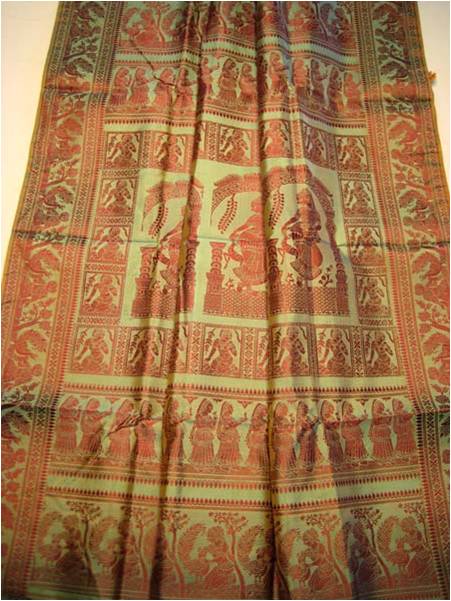
  • The sari has large flowing kalka motifs in the centre surrounded by narrow ornamental borders.
  • These are framed by a series of figural motifs worked in rows around the kalkas.
  • The four traditional colours are blue, yellow, red and green. The motifs are entirely in silver zari. 
  • It is usually five yards in length and 42" wide.
  • The body of the saree is covered with small butis and a beautiful floral design runs across the edges.
  • The pallu has the main decoration depicting narrative motifs.
  • Nowadays Baluchari style sarees are woven using highly mercerised cotton thread and silky threadwork ornament in bold colors.
  • The Baluchari saris are characterized by artistic motifs depicting scenes from Ramayana or sculptures made on historical temples weaved on the sari borders.


Chanderi from Madhya Pradesh

  • Chanderi refers to a shimmering cotton fabric which is famous for being light weight and having sheer texture and glossy transparency. Practiced exclusively in a town called Chanderi in Madhya Pradesh.
  •  Saris weaved out of chanderi are best for summer wear.
  • Motifs used in chanderi weaving are mostly inspired from nature (earth and sky) and chanderi tempels.
  • Few of them are Swans (hamsa), gold coins (asharfi), trees, fruits, flowers and heavenly bodies.
  • Another interesting feature of the Chanderi Saree which distinguishes it from other is its rich gold border and two gold bands on the pallu.
  • Soft pastel hues characterize chanderi fabrics.
  • bright colour borders on an off white base, or red on black, also exist now.


Tanchoi from Gujrat

  • The Tanchoi saree is one of most popular variety of the traditional silk sari from Gujarat.
  • The technique of weaving Tanchoi saris was brought to India form China.
  • The name came from the three Choi brothers who brought the technique to our country.
  • Some extra threads are added to give the saris an appearance embossed of being embroidered.
  • The technique is similar to that of brocade
  • Tanchoi saree resembles a fine miniature with vibrant colours.
  • The usual ground is bright blue, purple, green or red. Sometimes the pallu is done more solidly with peacocks, fowers.
  • In tanchoi sarees, the designs are alway floral and birds like flying birds, paired cocks
  • Tanchoi silk sarees are also in dazzling floral, geometrical and paisley designs.
  • The Tanchoi silks are one of the most favored varieties of wedding saris preferred by the women.
  • These are generally of the heavy silk type. Thus they appear gorgeous when worn during the weddings and on other festive occasions.
  • Tanchoi saris of Gujarat generally have a satin finish.


Kanjeevaram silk sarees from Tamil Nadu

  • Kanjeevaram silk sarees are the most well known of Indian silk sarees fromTamil Nadu. They famous for their royal look and rich feel.
  • The Kanjeevaram sari gets its name from the town - Kanchipuram, a little temple town in Tamil Nadu.
  • The Kanjeevaram sari is made of a heavy silk called Kanjivaram silk, it is almost thicker than other silk and expensive and durable that it can be washed in water at home.
  • They make this varity from Korean and Chinese silk but only mulberry silk produced in Karnataka and few parts of Tamil Nadu, is right silk for the classic Kanjeevaram sari.
  • The weaver creates the border, body and pallu separately and then interlocks them together in an impossible to detach joint.
  • Weaver takes about 10-12 days to weave a simple Kanjeevaram sari while decorative ones could take up to 20 days. Kanjeevarams are favoured for their durability.
  • The common motifs are Peacock and parrot are the most common motifs. with traditional patterns derived from the Pallava temples, palaces and paintings.
  • the 'zari' work in the border and the Pallu are generally woven in gold-dipped silver threads.


Elements of fashion illustration and costumes in the 20th century

Elements of fashion illustration

  • Fashion illustration is the communication of fashion that originates with illustration, drawing and painting.
  • Fashion illustration has been around for nearly 500 years.
  • Ever since clothing has been in existence there was a need to translate ideas into a garment there has been a need for fashion illustration.
  • Fashion illustration shows the presence of the fabric texture through the art and gives a visual luxury.
  • It found a decline in late 1930s when vogue began to replace its illustrated cover page with photographic images.
  • Now it has gone from being one of the sole means of fashion communication and having a very minor role.
  • Some of the famous past illustrators are Andy Warhol (coco cola bottle, tomato sauce, bottle, and Marilyn Monroe), Kenneth Paul Block, Antonio Lopez, etc…
  • Initially the tailors or the dress makers used artist’s help to transfer their ideas on the paper.
  • Those illustrations had natural figures which gradually changed towards exaggerated fashion illustrations.

Art and costumes in the 20th century

  • The invention of photography made artists themselves to move away from representing reality and moved gradually from the impressionist representation of the world towards greater abstraction.
  • In the earlier centuries the work of artist showed how clothing appeared and at the same time the lines, proportion, and decoration of clothing embodied the artistic spirit.
  • In 20th century much of the art does not show us how clothing appeared but we can still see many connections between the visual art and dress in areas such as line and proportion in the design of textiles.
  • The issue of considering clothing as an art arose only after the establishment of haute couture
  • If we accept the idea of the designer as an artist work it is not surprising to find that like other artist of any period .
  • The designer produce at least two new lines of clothing each year.

Fashion cycle and Fashion theories

Evolution of fashion cycle
Fashion acceptance is usually described as a fashion cycle.
The fashion cycle is usually depicted as a bell shaped curve with 5 stages.
  1. Introduction
  2. Rise in popularity
  3. Peak of popularity
  4. Decline in popularity
  5. Rejection
Introduction of a style
  • Most new styles are introduced in the high level.
  • Designers creates the designs with few limitations on creativity, quality of raw material or amount of fine workmanship.
  • The create new apparel and accessory style by changing elements like line shape color ect…
  • Product costs are high and only few can afford.
  • Production in small quantity gives the designer more freedom, flexibility.
  • New products are shown to retail buyers and press.
  • At the first stage of cycle, fashion implies only style and newness.
  • Celebrities, TV stars, models buy these clothes as they want to wear them in some events.
Increase in popularity
  • When new styles are seen worn by celebrities on TV or magazines they attract the attention of the general public.
  • Viewers may wish to buy the new styles but perhaps cannot afford them.
  • Manufactures use less expensive fabric and modify the designs to sell in low price.
  • Some companies also do imitation of designer originals at low prices.
  • High priced designers now have secondary sales line which sell at lower prices so they are able to sell adoptions of their original designs in great quantity.
Peak of popularity
  • When fashion is at height of popularity it may be in such demand that more manufactures copy it or produce adaptations of it at many price levels.
Decline in popularity
  • After so many designs copies are mass produced, people get tired of that style and begin to look for something new.
  • Consumers still wear garments in style but they don’t buy them at regular prices.
  • Retail stores put declining styles on the sale rack.
Rejection of a style

  • In the past fashion cycle some consumers must have already turned to new look.
  • The rejection of a style just because it is out of fashion is called consumers obsolescence.
  • “FASHION WEARS OUT MORE APPAREL THAN THE MAN”

Length of cycles

  • Fashion always follows the same cyclic pattern.
  • There is no measurable time table for a fashion cycle.
  • Some takes short time to peak and popularity and some takes longer.
  • Some decline slowly some very fast
  • Some styles will sell in a single season some several seasons
  • Some fashion fades quickly others never disappear.

Classic


  • Some styles never become complete obsolete, but interest remain more or less accepted for an extended period.
  • Jeans, A-line kurtha, polo shirt, loafers and sari is a very good example for classic fashion.
Fads
  • Short lived fashion is called fad.
  • They lack the design strength to hold consumers attention for a long time.
  • Piercing, tattoos, spikes, sleeves, neck lines…are some good examples for fads.
Cycles within cycles
  • Design elements such as colour, texture, silhouette may change even though the style itself remains popular.
  • Jeans is a good example (skin fit, boot cut, low waist, high waist, different washes, torn jeans)

Fashion theories
Adaptation of fashion

  • To understand how new fashion ideas are spread and how they are adapted to the taste, life-style and budgets of various costumers.
  • Basically there are three variations of the fashion adaptation process traditional adaptation, reverse adaptation, and mass dissemination.

Trickle-down theory (traditional adaptation)

  • It is based on the traditional process of copying and adapting trendsetting fashion from, Paris, London, New York designers.
  • Couture designer fashion is expensive and it is affordable by only a few people.
  • Those designs are copied again and again at lower prices until they have been seen often by the conservative buyers.
  • It starts from to high fashion to the common people.

Trickle-up theory (reverse adaptation)

  • It starts from street fashion to high fashion.
  • Since 1960s designers and manufactures pay more attention to the customers innovations .
  • They watch people on street to find ideas.
  • The “gypsy” look is a good example of a street look which reached the runway.

Trickle-across theory (mass dissemination)

  • Modern communications bring fashion from around the world into our homes instantly.
  • Many separate markets have developed to various age range, life style, tastes.
  • Various designer and manufacturer labels appeal to various market segments at different price points.
  • Mass production means that many different styles can be accepted at a same time.

Fashion origin

Fashion Origin
The center of fashion
  • Until the industrial revolution the people belonged to two main classes the wealthy landowners and poor labor and farmers.
  • During 18th century Paris became the fashion capital of Europe.
  • The textile industries grew in the French cities supplying with silk fabric, ribbon and laces.
Hand sewing by dress makers and tailors
  • All cloths are not only hand made but also custom made.
  • Each garment was made to fit the customer’s exact measurement.
  • Poor people wore cast off clothing from the rich or made their own clothing.
Growth of couture
  • The costume made garments are called as couture.
  • France became the center of fashion because of the development of silk industry.
  • A male designer was a couturier.
  • A female designer was a couturiere.
  • Haute couture was found in the same period in which the sewing machine was invented.
  • The father of haute couture is Charles worth who was the first successful designer born in England and came to Paris at the age of 20.
  • He took prominent women as his clients like wife of emperor Napoleon III.
  • Other couture houses followed Worth.
  • Most people could not afford couture clothes but they managed to copy them.

Effects if industrial revolution on fashion
  • Most materials were imported from abroad like silk from China, India, Italy.
  • The modern textile industries were developed which enabled more fabrics to be produced in less time.
  • Complete textile production from raw cotton fiber to finished cloths are done by one company.
Growth of the middle class
  • Great economic , social, and fashion changes happened throughout the western world in the late 18th century.
  • Trades and industries in turn created the middle class with money to spend on the luxuries of life including better clothing.
  • Money gave power to the new middle class not only in business and society but also to influence fashion trends.
  • Fashion became a status symbol and a visual image to show off wealth.
Mass production of clothing
Invention of the sewing machine.
  • The mass production was made possible with the invention of the sewing machine which turned a handicraft into an industry.
  • In 1859 Isaac Singer mass produced sewing machines .
  • He developed a foot treadle an improvement that left the hand free to guide the fabric.


Women’s fashion reflects social changes
  • Fashion conveyed the rigid difference between the roles of the sexes.
  • Men wore trousers which became the symbol of dominance.
  • Women wore constraining garment showing their restricted life style.
  • They did not have rights to own anything other than their wardrobes which made them more interested towards clothes.
Mass production of women separates
  • The introduction of separate blouses and skirts in the 1880s made it possible to manufacture the ready to wear garments.
  • Blouse is made to fit shoulder and bust measurement and skirt to fit the hip and waist line.
  • The cost of the ready made garment was less than half cost of the custom made garment.
Children’s fashion
  • The wealthy were the only ones who had money to spend for fashionable children’s clothing.
  • The working class and middle class made their children garment at home.
  • As they grew older children where suppose to act like adults and they are dressed with the miniature version of the adult garments. (remake of their parents).
The effects of the world war on the fashion

  • World war influenced women to wear shorter skirts and dresses.
  • The more obvious of these was in a move by women in more into more comfortable, and practical clothes that were required for their more active participation in the variety of jobs that they had taken over from men
  • During the war women worked in factories and it was dangerous to have long hair and long dresses. Women working in factories had to cut their hair, and raise hemlines.
  • The war affected colors and fabrics. Wool was in shot supply as it was used to manufacture the uniform for fighting men. The scarcity of chemicals used for certain dye stuff restricted the use of dark color.